A Construction Site Cannot Be Managed by Rules Alone
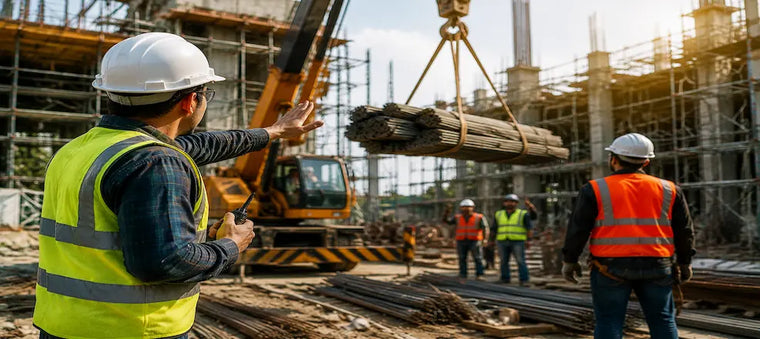
Picture a typical active site: several contractors working side by side, conditions shifting from one day to the next, and equipment, materials, and people moving constantly across the same footprint. A printed safety plan sits in the site office, but nobody is quite sure who owns which control or who signs off on what. A safe construction site is not created by PPE, warning signs, or paperwork alone — it requires a working site safety management system that connects leadership, planning, risk control, training, communication, inspection, and continual improvement into one coherent process.
Quick Answer: What Is a Site Safety Management System?
A site safety management system is a structured framework for identifying construction hazards, assigning safety responsibilities, controlling risks, training workers, coordinating contractors, inspecting work, reporting incidents, and improving safety performance throughout a project. Rather than treating safety as a stack of documents, it turns safety into a repeatable, managed process that runs alongside the project itself.
What Is a Site Safety Management System?
At its core, the system brings together a safety policy and clear objectives, defined roles and accountability, hazard identification, construction risk assessments, operational controls, worker consultation, contractor coordination, training and competency requirements, emergency arrangements, inspections and audits, corrective action, and management review. Each element feeds the next, so hazards identified on Monday translate into controls, training, and verification by the time work resumes.
Safety Management System vs. Construction Safety Plan
|
Safety management system
|
Construction safety plan
|
|
Organisation-wide or project-wide framework
|
Site-specific working document
|
|
Defines processes and responsibilities
|
Describes arrangements for a particular project
|
|
Runs through planning, operation, review, and improvement
|
Updated as site conditions change
|
|
Includes monitoring and management review
|
Includes site rules, hazards, controls, and emergency procedures
|
The construction safety plan is the practical document that operates inside the wider management system — one is the engine, the other is the map for a specific job.
Eight Essential Elements of a Construction Safety Management System
1. Management Leadership and Safety Policy — Written commitment, allocated resources and budget, clearly communicated expectations, visible leadership by example, and measurable safety objectives.
2. Worker Participation and Communication — Genuine worker consultation, hazard reporting without retaliation, toolbox talks, regular safety meetings, near-miss reporting, and stop-work authority. Worker participation is one of OSHA's core safety-program elements, alongside leadership, hazard assessment, hazard prevention, training, evaluation, and contractor coordination.
3. Hazard Identification and Construction Risk Assessment — Pre-construction reviews, task-level assessments, attention to changing site conditions, coverage of both routine and non-routine work, simultaneous operations, and exposure to vulnerable workers and the public.
4. Hazard Prevention and Operational Control — Controls applied in order of priority: elimination, substitution, engineering controls, administrative controls, and PPE as the last line of defense.
5. Legal and Other Requirements — National legislation, local building and safety regulations, client standards, contractual requirements, applicable OSHA requirements, ISO 45001 principles, and relevant industry codes.
6. Competence, Induction, and Safety Training — Site-specific induction, role-based training, equipment authorisation, ongoing toolbox talks, refresher training, and verification that understanding actually occurred.
7. Emergency Preparedness and Incident Management — A tested emergency response plan, rescue arrangements, first aid provision, fire response, incident reporting, accident investigation, and follow-through corrective action.
8. Monitoring and Continual Improvement — Inspections, audits, leading and lagging indicators, management review, and lessons learned fed back into the system.
These eight elements map closely to the Plan–Do–Check–Act cycle used in ISO 45001, which identifies leadership, worker participation, risk assessment, legal compliance, emergency planning, incident investigation, auditing, and continual improvement as the major components of an occupational health and safety management system.
How to Build a Site Safety Management System in Eight Steps
Step 1 — Define the Scope and Safety Responsibilities. Map out the client, project manager, principal or main contractor, site manager, safety manager, supervisors, contractors, and workers, using a responsibility matrix where useful.
Step 2 — Identify Applicable Requirements. Build a register of laws and regulations, permits, client requirements, codes of practice, internal standards, and contractual obligations. OSHA's Recommended Practices for Safety and Health Programs is a useful reference point here.
Step 3 — Complete the Initial Hazard and Risk Assessment. Assess project phases, site layout, work activities, equipment, materials, interfaces between trades, and environmental and public risks.
Step 4 — Develop the Site-Specific Safety Plan. Cover project details, responsibilities, site rules, risk controls, safe work procedures, permit-to-work arrangements, traffic management, welfare facilities, emergency arrangements, and inspection schedules. HSE guidance stresses preparing the construction plan before work starts, using pre-construction information to identify risks early.
Step 5 — Establish Contractor and Subcontractor Controls. Require prequalification, competency evidence, insurance and licences, method statements, risk assessments, coordination meetings, and ongoing performance monitoring.
Step 6 — Train, Induct, and Communicate. Deliver site induction, toolbox talks, competency checks, multilingual communication where needed, and briefings whenever conditions change.
Step 7 — Inspect, Report, and Correct. Set up daily supervisor checks, formal inspections, hazard and near-miss reporting, and corrective actions with clear owners, deadlines, and verification.
Step 8 — Audit, Review, and Improve. Revisit the system after incidents, new contractors coming on board, design changes, new equipment, new project phases, regulatory changes, and audit findings.
Professionals who need a structured understanding of hazard control, site planning, contractor coordination, and accident prevention can strengthen their knowledge through the [Construction Safety (Site Safety Management)] course.
Critical Controls the System Must Manage Every Day
Work at Height
- Guardrails
- Safe access
- Scaffold controls
- Fall-restraint or fall-arrest systems
- Rescue planning
Excavation, Electrical, and Equipment Risks
- Service detection
- Ground stability
- Isolation procedures
- Equipment inspections
- Competent operators
- Exclusion zones
Traffic, Lifting, and Site Organisation
- Vehicle routes
- Pedestrian segregation
- Lifting plans
- Signallers
- Housekeeping
- Material storage
PPE is not the complete system — it is the last resort, not the first line of defense. These hazards need to be controlled through design decisions made before work starts, careful planning, engineering controls, active supervision, written procedures, and ongoing verification that controls are actually being used. A guardrail that exists on paper but not on the scaffold protects no one.
The ILO's Safety and Health in Construction Code of Practice reinforces this approach. The revised code promotes OSH management systems, cooperation between employers and workers, and a preventative safety culture that runs across the entire construction-project lifecycle, rather than safety measures applied only at isolated points in a project.
How to Measure Construction Safety Performance
Leading Indicators
- Percentage of inspections completed
- Corrective-action closure rate
- Toolbox-talk participation
- Training completion
- Hazard and near-miss reports
- Supervisor safety observations
- Contractor compliance scores
Lagging Indicators
- Recordable injuries
- Lost-time incidents
- Property damage
- Regulatory violations
- Workdays lost
- Incident severity
Low accident numbers alone do not prove a system is working — a quiet month can just as easily mean underreporting as it can mean genuine safety. Leading indicators matter because they show whether the preventive activities that actually stop incidents — inspections, training, hazard reporting, and closed corrective actions — are happening in practice, not just on schedule.
Common Site Safety Management Mistakes
- Copying a generic construction safety plan instead of tailoring it to the actual site.
- Treating risk assessments as one-time paperwork rather than a living process.
- Failing to coordinate subcontractors into the same safety system.
- Measuring injuries without measuring the preventive activities that prevent them.
- Leaving corrective actions open or unverified after they're raised.
The system only works when it stays site-specific, active, documented, and regularly reviewed — not filed away once the plan is approved.
Develop Practical Site Safety Management Skills
Building an effective system requires more than knowing individual safety rules. Professionals must understand how risk assessment, leadership, documentation, contractor control, inspections, and incident learning work together as one connected process. The [Construction Safety (Site Safety Management)]course can help learners develop practical site safety management skills for construction supervision, safety coordination, compliance, and career development. It covers site risks, safety planning, contractor coordination, hazard controls, incident learning, and accident prevention.
Build a System, Not Just a File
Construction safety improves when leadership, workers, plans, controls, inspections, and lessons learned operate as one system — not as disconnected documents completed only for compliance.