Working at Height Safety

Learn fall prevention, rescue planning, and compliance essentials in this practical online working at height training course.
  • Fall Risk Assessment
  • Hierarchy of Controls
  • Rescue Planning
  • Equipment Competence
  • Compliance Awareness
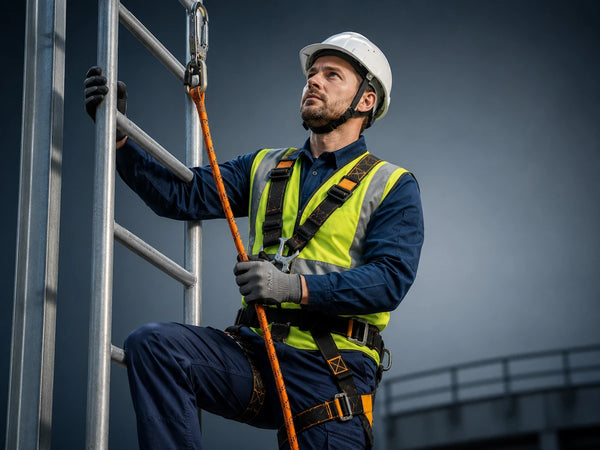
European construction worker wearing safety helmet, high-visibility vest, gloves, and fall-arrest harness, climbing an industrial ladder while securely holding a safety rope, demonstrating proper working at height and fall prevention practices

Overview

Working at height training is essential for anyone whose job involves working on ladders, scaffolds, rooftops, or elevated platforms, because falls from height remain one of the leading causes of workplace injury and fatality worldwide. Many organizations, including the International Labour Organization and national safety regulators such as the UK's Health and Safety Executive and the US Occupational Safety and Health Administration, continue to identify falls as a top-priority workplace hazard. This makes working at height training a critical requirement for construction, maintenance, telecommunications, and facilities management roles across the globe.

This course helps learners understand how falls happen, how to assess and control fall risks, and how to respond effectively if an incident occurs. Rather than focusing on theory alone, the course connects regulatory knowledge to practical, real-world scenarios that learners are likely to encounter on site. As a result, learners finish the course with a clear, applicable understanding of fall prevention rather than just a checklist of rules.

Whether you're an employee required to complete mandatory safety training, a supervisor responsible for your team's safety, or a safety professional building your credentials, this course is structured to meet global compliance expectations. It draws on UK, EU, and US regulatory frameworks, making it suitable for learners working under multiple jurisdictions.

Group of European construction workers wearing full PPE, safety harnesses, helmets, and gloves, gathered around a supervisor discussing working at height safety procedures on scaffolding at an outdoor construction site.

Learning Outcome

By the end of this course, learners will be able to:

  • Understand the physics of falls and how fall-arrest systems reduce injury risk
  • Identify fall hazards across common work-at-height environments
  • Apply the hierarchy of controls to avoid, prevent, and arrest falls
  • Recognise the legal responsibilities of employers, supervisors, and workers
  • Assess risk using structured hazard identification methods
  • Implement collective protection systems such as guardrails and scaffolds correctly
  • Follow personal fall-protection equipment procedures and manufacturer guidance
  • Develop a basic rescue plan for work-at-height emergencies
  • Manage suspension trauma risk and time-critical casualty response
  • Demonstrate awareness of compliance auditing and continuous improvement practices

Who is This Course Suitable For?

This course is ideal for:

  • Beginners with no prior safety training who need a foundational understanding of fall risks
  • Employees in construction, roofing, telecommunications, and warehousing where working at height is routine
  • Supervisors and team leaders responsible for enforcing fall protection training for supervisors and site teams
  • HR and compliance professionals managing training records and audit readiness
  • Health and safety officers building specialist knowledge in fall prevention
  • Job seekers building workplace safety credentials to strengthen their CV
  • Employers and managers needing compliant workforce training across multiple sites
  • International professionals working under EU, UK, or US safety frameworks
  • Rope access and MEWP operators who need refresher knowledge on rescue procedures
  • Facilities and maintenance staff who occasionally work on ladders, roofs, or platforms

Requirements

  • No prior occupational safety knowledge required
  • Basic English reading and comprehension
  • An interest in workplace safety, risk reduction, or professional development
  • Access to a computer, tablet, or smartphone with internet connection
  • No specialist equipment or software needed
  • No formal prerequisites, making this working at height training course online accessible to all learners

Career Opportunities

Completing this course strengthens your credentials for a range of safety-focused roles across industries where height safety training is a hiring requirement.

Health and Safety Officer
Builds the risk assessment and compliance knowledge needed to monitor site safety. Salaries typically range from £24,000–£40,000 in the UK and $42,000–$68,000 in the US.

Site Supervisor
Prepares supervisors to enforce fall protection procedures and manage worker competence. Salaries typically range from £28,000–£45,000 in the UK and $48,000–$75,000 in the US.

Scaffolding Inspector
Applies collective protection knowledge to inspect and approve scaffold structures. Salaries typically range from £25,000–£38,000 in the UK.

Rope Access Technician
Supports readiness for IRATA/SPRAT-aligned rescue and rope access work. Salaries typically range from £22,000–£40,000 in the UK.

Compliance and Training Coordinator
Uses course knowledge to manage staff training records and audits. Salaries typically range from £26,000–£42,000 in the UK and $45,000–$70,000 in the US.

Construction Safety Advisor
Applies hazard identification skills to reduce fall-related incidents on site. Salaries typically range from £30,000–£48,000 in the UK.

Course Curriculum

5 sections20 lectures
History, Evolution, and Development of Working-at-Height Safety
Definitions, Core Principles, and Applications of Work at Height
Global Fall Statistics, Accident Trends, and High-Risk Industries
Physics of Falls, Impact Forces, and Fall-Arrest Principles
UK Work at Height Regulations 2005 and the Avoid–Prevent–Arrest Hierarchy
OSHA Fall-Protection Requirements and International Regulatory Frameworks
European Union Directives, EN Standards, and Equipment Certification
Employer, Supervisor, Worker, and Competent-Person Responsibilities
Working-at-Height Hazard Identification and Risk Assessment
Hierarchy of Controls: Avoiding, Preventing, and Arresting Falls
Collective Protection Systems: Guardrails, Scaffolds, and MEWPs
Personal Fall-Protection Equipment, Human Factors, and Safety Culture
Work-at-Height Rescue Planning, Resources, and Communication Procedures
Suspension Trauma, Medical Risks, and Time-Critical Casualty Management
Rope-Access Rescue Systems, Redundancy, and IRATA/SPRAT Readiness
Rescue Drills, Emergency Coordination, and Lessons from Real Incidents
Working-at-Height Compliance Programmes, Inspections, and Safety Audits
Ethical Responsibilities, Leadership Commitment, and Stop-Work Authority
Training, Competence Assessment, and Worker Empowerment
Dropped-Object Prevention, Secondary Hazards, Vision Zero, and Continuous Improvement

Frequently Asked Questions

Working at height training teaches workers how to identify, assess, and control fall risks in elevated work environments. It covers regulations, equipment use, and rescue planning. The goal is to reduce the likelihood and severity of falls on site.

Many construction employers require working at height certification before assigning staff to elevated tasks. Requirements vary by country and employer policy. This course provides a strong foundation that supports compliance with common industry expectations.

In several countries, including the UK and EU member states, working at height is governed by specific regulations that require employers to ensure adequate training. In the US, OSHA sets fall-protection standards for many industries. Always check your local regulatory requirements.

You can complete this working at height training course online and receive a digital certificate upon completion. The course is self-paced, so you can study from any device with internet access. No in-person attendance is required.

Working at height training helps employees recognize hazards, use equipment correctly, and respond appropriately in an emergency. This reduces injury risk and supports a safer overall workplace. It also strengthens an employee's professional safety credentials.

Roles such as scaffolders, roofers, site supervisors, rope access technicians, and health and safety officers commonly require working at height certification. Many maintenance and telecommunications roles also request this training. Requirements depend on the employer and jurisdiction.

Yes, this course is designed for learners with no prior safety training. Concepts are explained clearly and built up progressively across the modules. It is equally useful as a refresher for experienced workers.