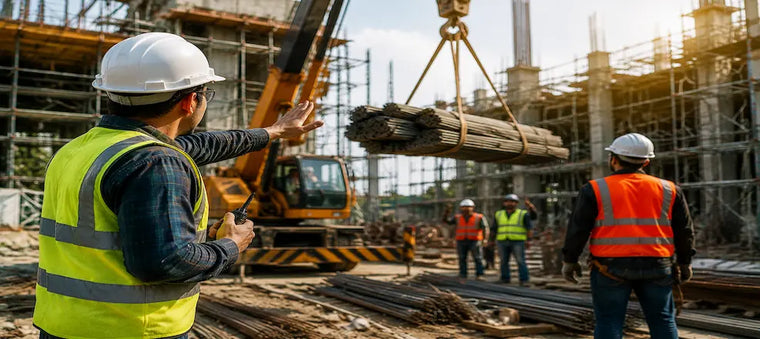
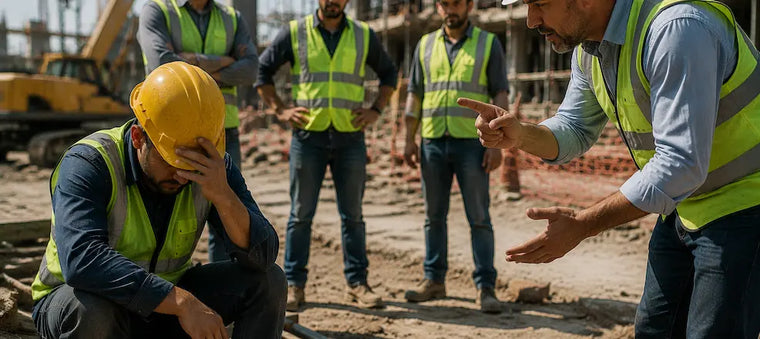
A construction incident investigation follows seven critical steps: respond immediately to ensure safety and notify authorities; preserve the incident scene to maintain evidence; organize the investigation team and scope; collect physical, documentary and digital evidence; conduct interviews with witnesses; analyze root causes; and implement preventive actions. This systematic approach prevents injuries, property damage and future near misses.
Seven Steps at a Glance
- Respond to the incident and complete immediate notifications
- Secure and preserve the incident scene
- Assemble the investigation team and define the scope
- Collect physical, documentary and digital evidence
- Conduct interviews with witnesses and involved parties
- Analyse findings and identify root causes
- Act on recommendations and implement preventive measures
Why Construction Incidents Must Be Investigated
Construction incidents are inevitable in high-risk environments. Picture this: a scaffold board falls into an exclusion zone, narrowly missing a worker and damaging equipment below. Without a thorough construction incident investigation, such near misses repeat until someone is seriously injured. The objective is prevention—not blame.
A systematic approach to workplace incident investigation protects workers, preserves evidence, and identifies systemic failures before they escalate. This method applies across construction, manufacturing, mining and other high-risk industries. By understanding what went wrong and why, organizations prevent recurrence and build a stronger safety culture.
Global Compliance Note
In the United States, OSHA rules establish mandatory reporting and investigation requirements for relevant workplaces. Other countries maintain their own occupational health and safety frameworks. For broader international guidance on occupational accident investigation, refer to the ILO's occupational accident investigation standards, which provide best-practice frameworks applicable across jurisdictions.
Professionals who need a structured investigation method can strengthen their skills through our Incident Investigation / Root Cause Analysis course.
Step 1: Respond to the Incident and Complete Immediate Notifications
Immediate response is everything. Your first priority is life safety: provide first aid, call emergency services, and isolate hazards to prevent further harm. Do not allow the investigation to interfere with rescue operations.
Once the emergency stabilizes, notify management, HSE personnel, and relevant authorities. Clear incident reporting protocols ensure nothing is missed. In the U.S., employers report directly through OSHA's fatality and severe injury reporting portal, available by phone or online 24 hours a day. Document the time, location, nature of harm, and immediate actions taken. Notify workers' compensation insurers and union representatives if applicable.
Begin the investigation promptly, but recognize that some information gathering can wait until the immediate crisis passes. A delayed investigation is better than a chaotic one conducted during active rescue operations.
U.S. Reporting Note
Under OSHA's current rule, a work-related fatality must generally be reported within eight hours, while an inpatient hospitalization, amputation or loss of an eye must generally be reported within 24 hours. Clearly label this as a U.S. requirement and consult OSHA's official reporting rule to confirm applicability to your workplace. Non-U.S. organizations should verify their own reporting deadlines.
Step 2: Secure and Preserve the Incident Scene
Accident scene preservation is non-negotiable. Establish an exclusion zone with barriers, tape and signage. Prevent equipment, tools, PPE and materials from being moved unless absolutely necessary for rescue or hazard control.
If unavoidable changes must be made, record them meticulously—photograph the scene before and after any movement. Capture wide-angle shots showing the full layout, medium-distance shots of key areas, and close-up photographs of damaged components, tool marks, and damage patterns.
A photograph taken within hours of an incident preserves details that memory cannot. Train your team to document the scene as if presenting evidence to an investigator or regulator.
Step 3: Assemble the Investigation Team and Define the Scope
Investigation quality depends on team composition. Assemble a diverse team:
-
HSE Lead: Manages the investigation and ensures compliance
-
Supervisor: Provides operational context
-
Worker Representative: Offers frontline perspective and credibility
-
Technical Specialist: Brings domain expertise (e.g., structural engineer, electrician)
-
Contractor Representative: If subcontractors were involved
Define the scope clearly: What is the event? Where does investigation begin and end? What expertise is needed? Who owns each responsibility? When is the final report due?
Avoid conflicts of interest—an investigator cannot be a defendant in the incident.
Step 4: Collect Physical, Documentary and Digital Evidence
Incident evidence collection is systematic and thorough. Gather:
Physical Evidence: Photographs, damaged components, tools, PPE, materials
Documentary Evidence: Permits, risk assessments, job hazard analyses (JHAs) and job safety analyses (JSAs), training records, inspection reports, maintenance records
Digital Evidence: Shift logs, CCTV footage, equipment sensors, weather records
Create an evidence log listing every item, its condition, location found, and chain of custody. This log proves evidence integrity if your investigation leads to legal proceedings or regulatory review.
Step 5: Interview Witnesses and Reconstruct the Timeline
Incident witness interviews are the foundation of timeline analysis. Interview witnesses separately and as soon as reasonably possible—memory fades quickly. Use open questions such as "What did you see?" rather than leading questions like "The scaffold board fell, didn't it?"
Compare witness statements with physical and documentary evidence. Discrepancies often reveal perception gaps, communication breakdowns or unreported hazards. Build a timeline showing:
- Normal work patterns before the incident
- Changes to procedures, equipment or personnel
- Warning signs that were noticed or ignored
- The incident itself (moment by moment)
- Response actions taken
A clear timeline reveals when things changed and why.
Step 6: Identify Immediate, Underlying and Root Causes
Root cause analysis requires discipline. Define the four causal levels:
Immediate Cause: The direct action or condition that triggered the incident (e.g., scaffold board not secured)
Contributing Factor: Conditions that made the incident more likely (e.g., wind speed increased)
Underlying Cause: System weaknesses that allowed the immediate cause (e.g., no inspection checklist)
Root Cause: The foundational organizational failure (e.g., safety-inspection procedures not enforced)
Do not stop at "the worker was careless." OSHA advises investigators to look beyond individual behaviour and identify equipment, procedure, training and safety-management deficiencies. Carelessness is a symptom of flawed systems, not a root cause.
Root Cause Tools
5 Whys: Ask "why?" after each answer to progress toward root cause. Why did the board fall? Because it wasn't secured. Why wasn't it secured? Because inspection was skipped. Why was inspection skipped? Because no accountability existed. Why no accountability? Because procedures were not enforced.
Fishbone Diagram: Organize causal categories (people, processes, equipment, environment, materials) and identify deficiencies in each domain.
Fault Tree Analysis: For complex technical failures, map how multiple smaller failures combine to create the incident.
Timeline Analysis: Map causal factors chronologically to reveal relationships and decision points.
Structured training can help investigators select the right tool and avoid premature conclusions. Explore the Incident Investigation / Root Cause Analysis course.
Step 7: Write the Report and Implement Corrective Actions
The incident investigation report structures findings for clarity and action. Include:
-
Incident Details: Date, time, location, people involved, nature of harm
-
Investigation Scope: What was investigated and what was not
-
Evidence Summary: Physical, documentary and witness evidence collected
-
Timeline: Event sequence from normal work to response
-
Findings: Confirmed facts, separate from assumptions
-
Causal Analysis: Immediate, contributing, underlying and root causes
-
Corrective Actions: Specific controls with responsible owners and completion dates
-
Implementation Verification: How effectiveness will be tested
Use the hierarchy of controls rather than relying only on retraining or reminders. Elimination and substitution are stronger than administrative controls and PPE.
Action Verification
Actions are not complete merely because they were assigned. Verify implementation, test effectiveness and check whether similar hazards exist elsewhere. Link findings to the HSE investigation workbook, which structures investigation around gathering information, analysis, risk controls and action-plan implementation.
Five Common Incident Investigation Mistakes
Avoid these errors:
-
Blaming workers too early: Blame closes inquiry. Investigation opens it.
-
Failing to preserve evidence: Moved evidence loses context and credibility.
-
Asking leading questions: "The scaffold fell because it wasn't secured, right?" yields "yes" rather than truth.
-
Stopping at immediate causes: Without root-cause analysis, the same incident repeats.
-
Assigning vague actions without owners, deadlines or verification: Actions without accountability do not happen.
Seven-Point Construction Incident Investigation Checklist
-
Respond: Prioritise first aid, emergency response and hazard isolation
-
Secure: Establish exclusion zone and preserve the scene
-
Organise: Assemble investigation team and define scope
-
Collect: Gather physical, documentary and digital evidence
-
Interview: Conduct witness interviews and build timeline
-
Analyse: Identify immediate, underlying and root causes
-
Act: Implement corrective actions and verify effectiveness
Turn Every Incident into Preventive Action
An effective construction incident investigation converts raw evidence into organisational learning. Every incident—injury, near miss or property damage—reveals system weaknesses. By investigating thoroughly, identifying root causes and implementing genuine corrective actions, you prevent recurrence and build a stronger safety culture.
Structured training strengthens investigation skills and judgement. Explore the Incident Investigation / Root Cause Analysis course to equip your team.